Scientific Research
Selected academic research projects from my postdoctoral work and Ph.D., framed as concise case studies so you can scan each in under a minute, in the same format as the Industry Projects page.
GATA3 Regulatory Biology
Institution: CSIR-National Chemical Laboratory · Role: Project Scientist II · Period: 2023 – Mar 2024
Problem
The transcription factor GATA3 is a major regulator of luminal breast cancer, but its DNA-binding behavior across the diverse GATA motif landscape, and how that binding translates into regulatory signaling was not well characterized.
Approach
- Evaluated and benchmarked ChIP-seq tools for alignment, peak detection, and de novo motif analysis of GATA3 binding sites.
- Built ATAC-seq and RNA-seq pipelines for differential chromatin-accessibility and expression analysis.
- Integrated motif, binding, and expression signals to characterize the regulatory landscape of GATA3 in luminal breast cancer.
Outcome
- Findings published as co-author in Gharui, Puntambekar, et al., Biochemical and Biophysical Research Communications (2026) — “Recognition of diverse GATA motifs necessitates multimodal GATA3-DNA binding.”
Technologies
ChIP-seq, ATAC-seq, RNA-seq, de novo motif analysis, Regulatory network analysis
Pan-Cancer Analysis of Novel Open Reading Frames (nORFs)
Institution: Indian Institute of Science Education and Research, Pune (IISER-Pune) · Role: Postdoctoral Researcher · Period: 2018 – 2019
Problem
Transcripts encoding novel open reading frames (nORFs): short, previously uncharacterized peptides, were emerging as a potential class of cancer biomarkers and therapeutic targets, but they had not been systematically characterized across cancer types or assessed for clinical utility.
Approach
- Built a proteogenomic pipeline integrating publicly available RNA-seq and Ribo-seq data across multiple cancer types.
- Performed functional annotation, structure prediction, disease-mutation mapping, pan-cancer survival analysis, and in-silico drug screening to assess therapeutic and diagnostic potential of nORF-encoded peptides.
Outcome
- Findings published as co-first author in Erady, Boxall, Puntambekar, et al., NPJ Genomic Medicine (2021) — “Pan-cancer analysis of transcripts encoding novel open reading frames and their potential biological functions.”
Technologies
RNA-seq, Ribo-seq, Proteogenomic pipelines, Protein structure prediction, In-silico drug screening, Pan-cancer survival analysis
Comparative Transcriptomics of Cichlid Speciation
Institution: Indian Institute of Science Education and Research, Pune (IISER-Pune) · Role: Postdoctoral Researcher · Period: 2018 – 2019
Problem
Cichlid fishes are a textbook example of rapid speciation, but the genomic substrate that supports that speciation, particularly the role of de novo coding regions and accelerated evolution, was not well mapped using state-of-the-art comparative transcriptomics.
Approach
- Benchmarked state-of-the-art read alignment and assembly tools; built an optimized de novo + reference-based comparative-transcriptomics pipeline for two cichlid species.
- Performed phyloP-based evolutionary rate analysis to identify accelerated regions in the cichlid genome.
Outcome
- Findings published as first author in Puntambekar et al., Scientific Reports (2020) — “Evolutionary divergence of novel open reading frames in cichlids speciation.”
- Code and analysis on GitHub: learning_conservation_analysis_using_phylop.
Technologies
RNA-seq · de novo and reference-based assembly · phyloP · Comparative genomics · Evolutionary rate analysis
Mechanistic Modeling of Skin Pigmentation
Institution: CSIR-National Chemical Laboratory (Biosystems Analysis Lab) · Role: Doctoral Researcher (Ph.D.) · Period: 2011 – 2017
Problem
Clinical and experimental observations in skin pigmentation — including how IFN-γ regulates melanosome maturation, needed mechanistic explanations grounded in signaling-network dynamics, in collaboration with three experimental labs.
Approach
- Manually curated and reconstructed signaling and metabolic networks for melanosome transport and melanogenesis from primary literature.
- Built Boolean and ODE-based mathematical models to test hypotheses and propose mechanistic explanations for the experimental observations.
- Ran parameter estimation and sensitivity analyses to identify high-leverage nodes in the network.
Outcome
- Findings published as co-author in Natarajan et al., Proceedings of the National Academy of Sciences (PNAS) (2014) — “IFN-γ signaling maintains skin pigmentation homeostasis through regulation of melanosome maturation.”
- Doctoral-coursework literature review of mathematical models in skin pigmentation: PDF, presentation.
Technologies
Boolean modeling, ODE modeling, MATLAB, Parameter estimation, Sensitivity analysis, Network reconstruction, Cross-functional collaboration with wet labs
Mathematical Modeling of Sumoylation
Institution: CSIR-National Chemical Laboratory (Biosystems Analysis Lab) · Role: Doctoral Researcher (Ph.D.) · Period: 2011 – 2017
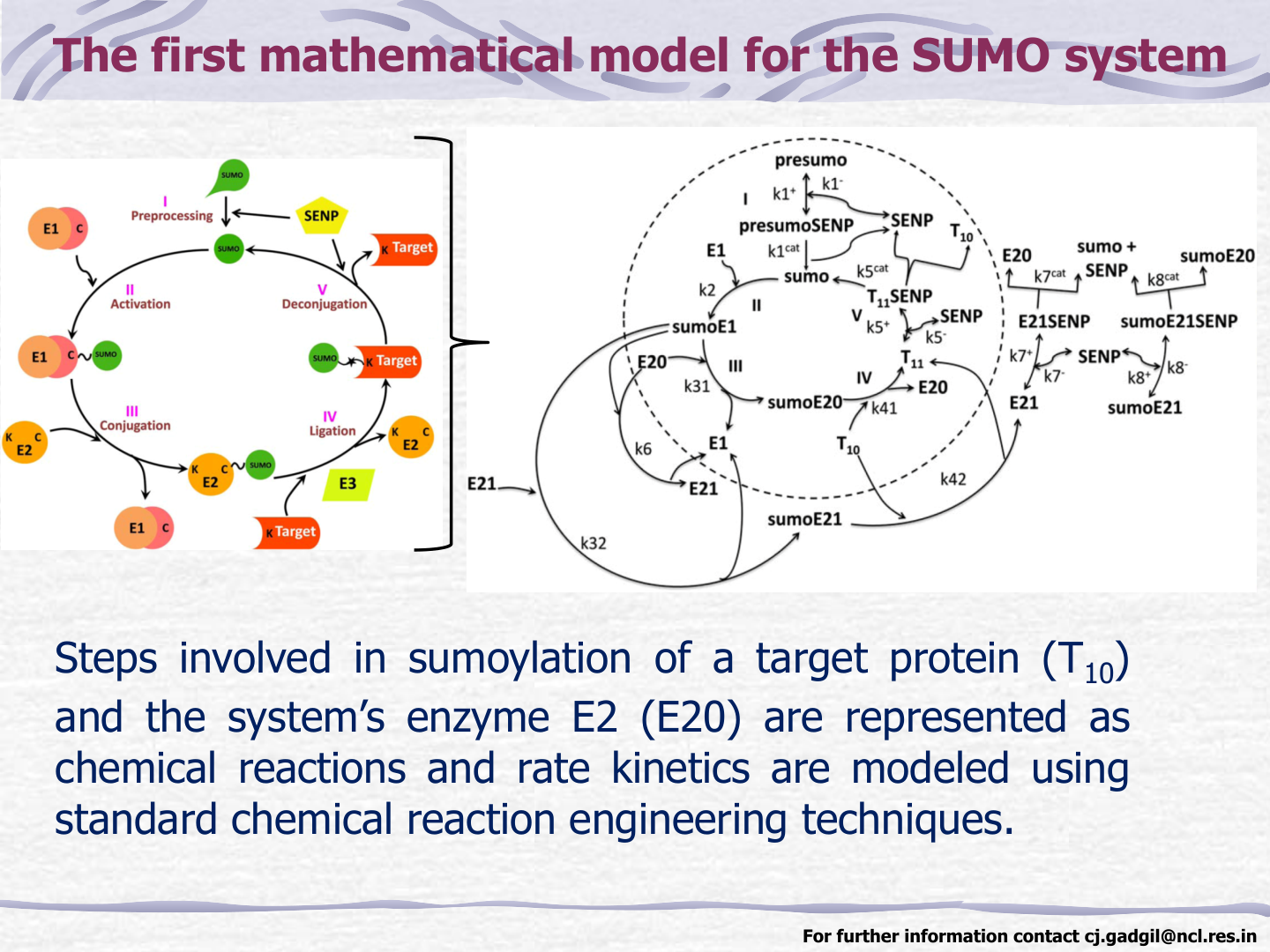
Reaction network of the SUMO conjugation system modeled in the paper. Adapted from Puntambekar et al., JBC (2016).
Problem
Sumoylation is a major post-translational modification system, but how SUMO modification levels respond to perturbations in enzyme activity — and which features of that response are non-obvious — required a model-driven analysis rather than purely descriptive biochemistry.
Approach
- Curated the sumoylation signaling network from primary literature.
- Developed an ODE-based mathematical model of SUMO conjugation dynamics.
- Ran steady-state and sensitivity analyses to identify counter-intuitive, system-level features of the network’s response to enzyme perturbations.
Outcome
- Findings published as first author in Puntambekar et al., Journal of Biological Chemistry (2016) — “Identification of unintuitive features of sumoylation through mathematical modeling.”
- Visual summary of the project (5-slide explainer originally prepared for CSIR-NCL): PDF download.
- Code on GitHub: Mathematical-model-for-sumoylation.
Technologies
ODE modeling · MATLAB · Steady-state analysis · Sensitivity analysis · Parameter estimation · Network reconstruction